

Back to Latest News
Blog: What Is Double Emulsion and How Does it Support Encapsulation?
Single vs Double emulsions
Encapsulation plays a vital role in modern formulation science, enabling manufacturers to protect sensitive active ingredients, control release profiles and improve product stability. One of the most effective techniques for achieving this is double emulsion, a process widely used in microparticle formulation for pharmaceutical, biotechnology and life science applications.
While double emulsions offer significant formulation advantages, producing them consistently at scale presents a considerable engineering challenge. The success of the process depends on preserving delicate internal droplet structures throughout manufacturing – something conventional processing technologies often struggle to achieve.
What is a Double Emulsion?
A double emulsion is an emulsion contained within another emulsion. The most common example is a water-in-oil-in-water (W/O/W) system, where tiny water droplets are first dispersed within an oil phase before that primary emulsion is dispersed again into an external water phase.
This structure enables formulators to encapsulate water-soluble active ingredients within protective droplets, helping shield them from degradation while allowing controlled release when required. Double emulsions are commonly explored for applications including drug delivery, biologics, vaccines and other formulations containing sensitive or highly targeted active ingredients.

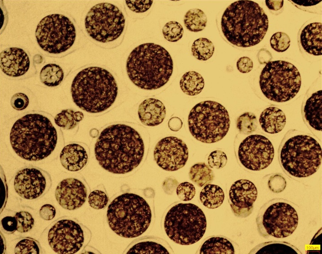
Double emulsion coacervate microcapsules (w/o/w system)
Why Conventional Processing Struggles
Creating the initial emulsion is only part of the challenge. During the second emulsification stage, the internal droplets must remain intact while the surrounding emulsion is formed.
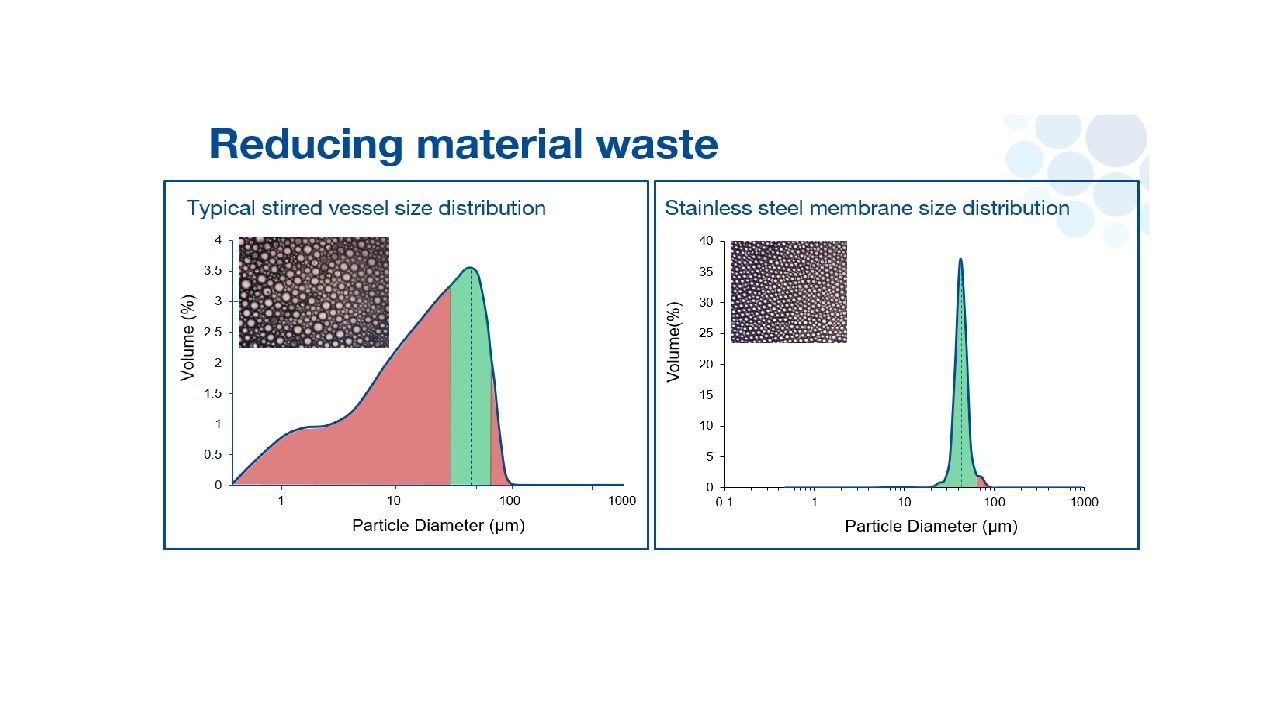
Traditional high-shear mixers and homogenisers rely on turbulent flow and intense mechanical forces to generate droplets. While effective for many conventional emulsions, these conditions often introduce excessive shear stress and heat during the second emulsification step. As a result, the delicate internal droplets can rupture, reducing encapsulation efficiency and compromising formulation performance. They can also make it more difficult to maintain a consistent particle size distribution throughout the manufacturing process.
For manufacturers, this can lead to inconsistent products, lower active ingredient protection and reduced process reproducibility.
Preserving Encapsulation Through Low-Shear Processing
Successful encapsulation depends on maintaining the integrity of the internal droplets throughout the manufacturing process. Rather than relying on turbulent droplet break-up, low-shear processing enables droplets to form under controlled, predictable conditions.
This approach offers several important advantages:
- Preserves delicate double emulsion structures throughout processing.
- Improves encapsulation efficiency by reducing droplet rupture.
- Protects sensitive active ingredients from unnecessary thermal and mechanical stress.
- Supports reproducible microparticle formulation and more consistent product quality.
Precision Particle Engineering with Advanced Crossflow Technology
Micropore's Advanced Crossflow (AXF™) technology provides a low-shear alternative to conventional emulsification methods. Instead of generating droplets through high-energy turbulence, AXF™ creates highly uniform droplets under controlled crossflow conditions, helping preserve the complex structures required for successful double emulsions.
By combining precision droplet formation with reproducible process control, AXF™ enables formulators to produce robust double emulsion systems while maintaining high encapsulation efficiency and protecting ingredient integrity. The technology also supports reliable scale-up, allowing the same core droplet formation principles to be maintained from early-stage development through to commercial manufacturing.

As demand grows for increasingly sophisticated drug delivery systems and complex formulations, technologies capable of delivering consistent, scalable encapsulation processes will become increasingly important.
To learn more about how Micropore Technologies supports advanced encapsulation and precision particle engineering, get in touch with our team: https://microporetech.com/
Need a formulation challenge solved? Ask a Micropore expert
At Micropore we enjoy working in partnership with our clients to solve formulation challenges and deliver the highest performing, most sustainable, most cost-effective formulated delivery systems.


Stay Informed
Keep up to date with innovations at Micropore. Sign up today to stay informed with innovations at Micropore and automatically receive the Micropore newsletter and webinar invites.
Quick Links
Contact
Micropore Technologies
Europe, Middle East, Asia: +(44) 1642 438367
Americas & Canada: +(1) (205) 639 3730
Terms of Use
Accessibility